

Ten Schengen 90/180 counting mistakes
The rule fits in a sentence, ninety days in any hundred and eighty, and most of the trouble comes from counting it the way people count everything else. These are the ten slips that turn up most often, and what the count actually looks at instead.
The Schengen short-stay rule is one of the few travel rules most people can recite: ninety days in any hundred and eighty. The arithmetic is not hard. What goes wrong is the method. People count it the way they count a holiday allowance or a gym membership, from a start date, per place, in nights, and the rule works in none of those ways.
This piece is about the counting only. Nothing here says whether a particular trip is permitted: that turns on the passport you hold and any visa you were granted, and the border and immigration authorities have the final word. The European Commission publishes a short-stay calculator as an aid to the count, not a ruling on it.
Where the count goes wrong
1. Expecting the count to reset. There is no 1 January and no 1 July in this rule. The window is the 180 days ending on whichever day you are asking about, and it moves forward by one day every day. Days fall out of it only by ageing past the back edge, never because a period has ended.
2. Counting each country separately. For the purposes of this rule the Schengen area is one place. A fortnight in Spain, a week in Greece and ten days in Sweden are one total of thirty-one days, not three small ones.
3. Counting nights instead of days. The day you arrive and the day you leave both count. A Friday to Sunday weekend is three days, not two nights, and a day trip across a Schengen border from outside the area is a whole day. This is where it bites: the date that counts is the date of the border check, in local time, which on an overnight or delayed journey may not be the date printed on your ticket.
4. Treating a short exit as a fresh start. Stepping out for a week does nothing except stop new days being added for that week. Everything already inside the window stays there until it ages out, so the total you return to is the same one you left, less only whatever has dropped off the back.
5. Checking the total once, on the day you arrive. The rule applies on every day of presence, not just at the border. A count that was fine on arrival day says nothing about day forty of the same stay, because each new day adds one at the front while the back edge may or may not be releasing any. A count is only as current as the date it was done for.
6. Counting from the itinerary instead of the journey. Bookings are plans. A cancelled flight, a missed connection or a decision to stay an extra night changes the dates that count, and a tally built from confirmation emails quietly records the trip you meant to take. The actual crossing dates are the ones that matter.
7. Getting the edge of the area wrong. Schengen and the European Union overlap without matching. Ireland and Cyprus are in the EU but outside Schengen, while Norway, Iceland, Switzerland and Liechtenstein are in Schengen but outside the EU. Membership has also moved recently, with Bulgaria and Romania joining fully in 2025, so a list remembered from a few years ago can put a week on the wrong side of the line. Check the current list rather than memory.
8. Mixing in days that were never short stays. Time spent in a country on that country's own residence permit or long-stay visa is generally not part of the ninety-day count. People who move between a long-stay status and ordinary short visits sometimes add the two together, and sometimes do the opposite and leave out short visits they made around it. Each day belongs to one kind of stay or the other, and the count only works if you know which.
9. Leaving the record to the border. Since April 2026 the EU's Entry/Exit System has recorded non-EU short-stay visitors' crossings electronically instead of stamping passports. That makes the official record better, but it is still a record held about you, not one you keep. When you want to check a date, or when a crossing was logged wrongly, the version you can produce yourself is the one you have to hand. Our piece on boarding passes and stamps goes into what kind of evidence holds up.
10. Treating the Schengen total as your tax count. Ninety days in the area tells you about permission to stay. It tells you nothing about whether any one country now regards you as resident for tax, which is counted per country, over its own year, often with more than days in play. The two counts share very little, as we set out in the Schengen rule is not a tax rule. The memories differ too. A border window forgets a day once it is 180 days old, while the UK's inheritance tax test, set out in UK inheritance tax and residence, looks back over the previous twenty tax years.
What most of these have in common
Read the list again and a pattern shows. Mistakes one, four and five are about the window. Two and seven are about the place. Three, six and eight are about which days are real. Nine is about who keeps the record, and ten about what the count is for. Almost none of them is an arithmetic error. Some apply good dates to the wrong window or the wrong place; the rest start from a list of dates that is incomplete or wrong, and no formula can repair that.
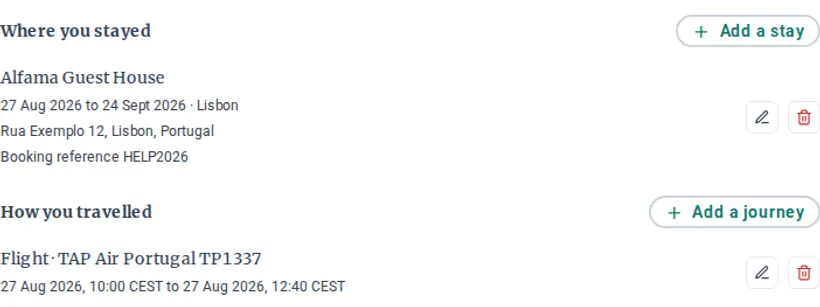
A travel record keeps that list: for each trip, the country, the date you arrived and the date you left, with the journey attached when you have it. Those dates then feed the residency day tracker's per-country counts. Whatever tool you use for the Schengen total, the Commission's calculator or your own spreadsheet, the answer can be no better than the dates you give it.